

Common concerns communities face when designing public safety facilities, and how to combat them
By Hillary Morgan, AIA, NCARB and Kevin Baughn, Associate AIA, CSI
In public safety facilities throughout the country, design and architecture determine who crosses paths, how the community interacts, where tensions rise and how elected officials, staff and the public move through buildings.
In facilities such as law enforcement buildings and courthouses, there is a natural tension between security and community. When applying modern and thoughtful design principles, public safety facilities can serve as a place to welcome as well as a place to be secure. The usage for these buildings is often twofold, if not more – a place to gather and a place to contain. For public safety facilities, it is pertinent to balance security, transparency and civic trust. These strategies must be embedded in the design of the facility itself rather than added after construction.
Police stations to serve all needs
This duality and tension are easily seen and faced in every community’s police stations. They are often seen as windowless structures that were planned with no thought of the community. Of course, police stations must be designed for their fundamental purpose of security and law enforcement, but they also need to be welcoming to the public. Police stations are spaces that must be hardened for some and softened for others. It’s a space with both secure and public environments and must balance unique needs.
From a security standpoint, the station should incorporate layered defenses and enhanced security measures for the safety of officers, inmates and the surrounding community. Critical areas in the station, such as interview rooms, must be secure and controlled for occupants and sensitive information.
At the same time, interview rooms for victims, families or the general public must be designed to be softened. It’s important that victims are in a space where they feel open and supported. The use of materials such as carpets and finishes helps to facilitate a softer environment. The room can be designed to have sofas and chairs instead of conference tables that may be typical in other interview rooms.
In addition, police stations support a wide range of services through multipurpose rooms that are accessible, efficient and cost-effective for the community. These environments should also be intentionally softened for public access, community engagement and transparency. Without this balance, police stations can feel intimidating and unapproachable to the very people they serve.
For example, incorporating dedicated community-oriented spaces is essential to fostering connections. Additionally, features like a multipurpose room for media and community events can help to bridge the gap between law enforcement and residents. Allowing the public into the facility is essential to building trust and reshaping perceptions around the police and the station itself.
The organization of the space is also critical. Creating clearly defined zones of separation to classify public and secure areas is helpful and necessary in police stations. Interiors should be durable and secure internally, while the exterior and public-facing rooms and elements should convey openness and approachability.
Solutions to welcome the public can also include designing welcoming public-facing elements, a visible reception upon arrival into the building and clear wayfinding. Together, these combined elements create an environment that is not only efficient and secure, but also inviting, transparent and rooted in the community it serves.
Contemporary courthouses
Modern courthouse design has evolved beyond the image of imposing stone facades and echoing halls. Today’s courthouses are expected to embody transparency, accessibility, safety and civic pride, all while also meeting highly technical operational demands. As communities invest in new judicial facilities, they often face a complex intersection of design concerns.
Understanding modern design approaches and how to address common concerns from the community can help ensure these buildings serve both justice and the public effectively.
Contemporary courthouse design begins with a fundamental shift; the building is no longer just a place where legal proceedings occur, but a civic institution that reflects a community’s values. Architects and planners must prioritize openness and public engagement. This means designs with light-filled atriums, visible courtrooms and intuitive layouts to reduce confusion and intimidation for visitors.

Security, as always, remains one of the most critical and sensitive elements of courthouse design. Modern facilities must protect judges, staff, jurors and the public while avoiding an atmosphere that may feel oppressive.
To achieve this balance, designers rely on the concept of zoning. Zoning creates separate circulation paths for the public, judiciary and in-custody individuals. Secure corridors, holding areas and discreet screening zones allow for safety and separation for each path without dominating the visitor experience.
Modern designs also incorporate adaptable courtrooms with movable furniture, scalable technology infrastructure and multipurpose spaces. This ensures that facilities can evolve without requiring costly renovations. For example, courtrooms can be designed to easily integrate video conferencing systems or accommodate different types of proceedings over time as technology changes.
Modern courthouse design is a careful balancing act, reconciling security with openness and durability with flexibility. While communities often approach courthouses with understandable concerns, thoughtful design strategies and meaningful public engagement can transform these into spaces that not only administer but also embody justice.
By addressing both functional needs and public perception, today’s courthouses can stand as enduring symbols of fairness, accessibility and community trust.
The benefits of co-location
Co-location is another strategy, utilized to combine facilities such as police stations, courthouses, detention facilities and emergency services in a shared or adjacent site. Many communities are shifting toward this trend and are building combined facilities.
This integrated design solution is on the rise for good reason. Co-location can alleviate logistical issues that arise from the transfer of inmates and can save the community money. By creating a controlled connection between facilities, it enhances both safety and efficiency.
Goodwyn Mills Cawood (GMC) has successfully implemented this design approach at the Montgomery County jail in Montgomery, Ala. The jail is located adjacent to the county courthouse and connected via a secure, enclosed bridge. This allows inmates to be escorted directly between the two places without ever leaving a controlled environment. Upon the completion of court proceedings, inmates return to the jail via the same route, eliminating any transportation risks and improving operational security.
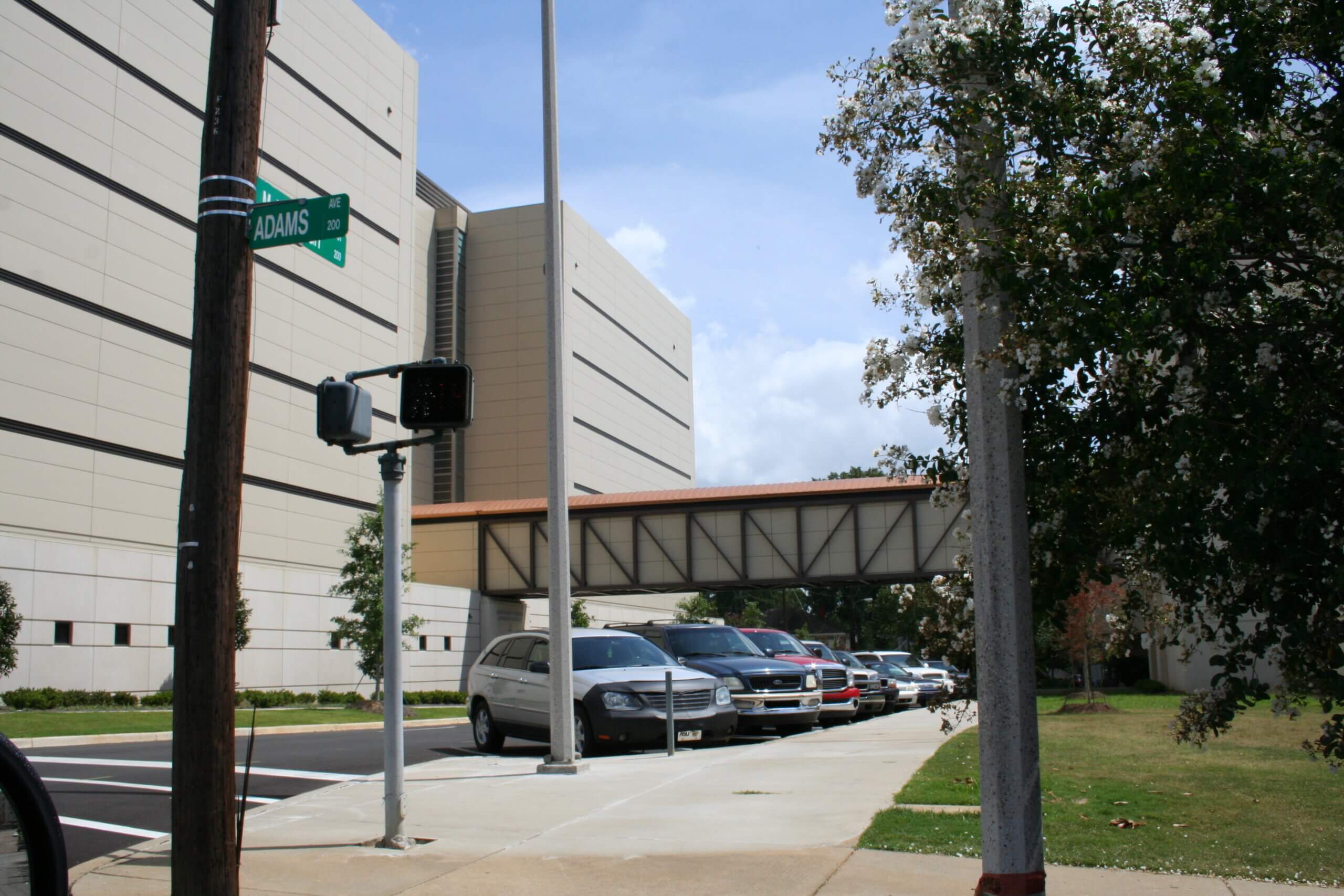
Beyond safety, co-location designs create a shared resource, enabling faster coordination and increased response across agencies. When thoughtfully planned and designed, co-location strengthens operations and efficiency.
Public safety facilities must evolve beyond purely defensive architecture. These places are not merely places for containment that offer security. Through modern and thoughtful design, public safety facilities can be used to build trust, support justice and enhance safety for all stakeholders.
Looking toward the future of justice design, communities increasingly expect facilities that reflect transparency, equity and humanity. To meet these expectations, designs must evolve because the most successful designs don’t just protect; they also connect, communicate and serve.